// home00
Pixel art portrait of MUHIB AL HASAN

MUHIB AL HASAN

Software Engineer - Full-stack & Applied AI

I lead backend and platform engineering for a multi-tenant SaaS product, including an LLM-powered structured data extraction pipeline. I design and operate production systems end to end, from microservices and event-driven processing to Kubernetes and observability, backed by peer-reviewed ML research.

guest@muhib-portfolio:~
Welcome to the interactive terminal. Type help for a list of available commands.
guest@muhib:~$
// featured systems01

Project Showcase

High-impact mobile applications, scalable cloud backends, government reporting systems, and automated scheduling engines.

Agentic RAG Copilot for On-Call EngineersRelease: 2026

RAG Copilot

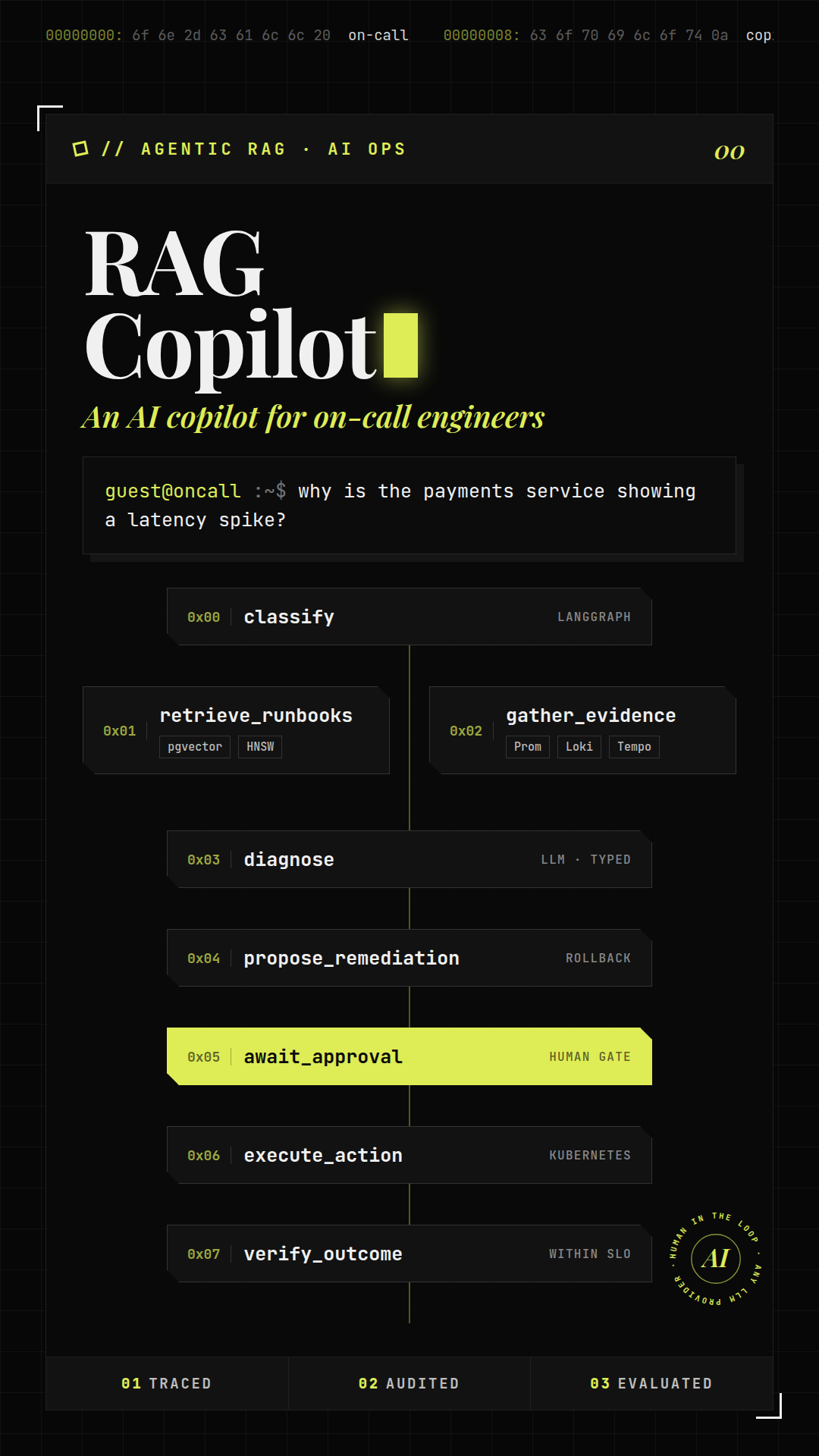
An AI copilot for on-call engineers. Ask "Why is the payments service showing a latency spike?" and it pulls runbooks and live telemetry, diagnoses the cause, proposes a fix, and executes it after human approval.

Role & Contribution:Solo Developer & Creator

Designed and built the agent workflow, RAG pipeline, approval flow, Kubernetes integration, evaluation harness, and React UI.

Problem: On-call engineers piece together runbooks and telemetry by hand during incidents, and letting an AI act on production is unsafe without strict limits.

Architecture: A LangGraph workflow retrieves runbooks (RAG over pgvector) and evidence from Prometheus, Loki and Tempo in parallel, then the LLM gives a structured diagnosis and picks an action from a typed list. Approved fixes run on Kubernetes and are verified against metrics.

Technical Decisions: Built the RAG pipeline on PostgreSQL and pgvector: Markdown split by headings, re-ingestion that skips unchanged documents, a vector index with filtered search, and a startup check that refuses to mix vectors from different embedding models. Defended against prompt and query injection: untrusted text is clearly marked in prompts, all model output is validated, queries come from fixed templates, and a person must approve every action. High-risk actions need a second superuser, and each action executes exactly once. Instrumented the AI itself with OpenTelemetry: one trace per run with a span for every step, tool and LLM call, including token usage, plus a saved record of the exact prompts behind every answer.

Outcomes: Shipped a production-style stack with 103 backend tests, 6 browser tests, Docker images and Kubernetes manifests verified on a local kind cluster. An LLM evaluation harness replays evidence recorded from the live system so only the model varies, applies rule-based checks, and reports pass rates per model, including a scenario that plants a malicious instruction in the logs.

>Technologies Used
LangGraphLangChainFastAPIPostgreSQL + pgvectorOpenTelemetryKubernetesReactTypeScript
// System Architecture Diagram
                  graph TD
    %% RAG Copilot agent workflow (LangGraph)
    Q["Question from on-call engineer"] --> Classify["classify"]

    Classify -- knowledge --> Docs["retrieve_documents"] --> Answer["answer_knowledge"]
    Classify -- investigate --> Runbooks
    Classify -- investigate --> Evidence

    subgraph Gather [Runs in parallel]
        Runbooks["retrieve_runbooks<br/>RAG over pgvector"]
        Evidence["gather_evidence<br/>Prometheus · Loki · Tempo · deployments"]
    end

    Runbooks --> Diagnose["diagnose<br/>structured LLM output"]
    Evidence --> Diagnose
    Diagnose --> Propose["propose_remediation<br/>typed action list"]
    Propose --> Approval{"await_approval<br/>human decision"}
    Approval -- rejected --> Stop["End"]
    Approval -- approved --> Execute["execute_action<br/>least-privilege Kubernetes"]
    Execute --> Verify["verify_outcome<br/>metrics back within targets"]

    subgraph Platform [Platform]
        PG[("PostgreSQL + pgvector<br/>runs, checkpoints, audit trail")]
        OTel["OpenTelemetry<br/>trace per run"]
    end

    Approval -. paused run saved .-> PG
    Verify -. spans and token usage .-> OTel

    classDef step fill:#121212,stroke:#deec56,stroke-width:1px,color:#fff;
    classDef gate fill:#1a1a1a,stroke:#deec56,stroke-width:2px,color:#deec56;
    classDef infra fill:#121212,stroke:#38bdf8,stroke-width:1px,color:#fff;

    class Classify,Docs,Answer,Runbooks,Evidence,Diagnose,Propose,Execute,Verify step;
    class Approval gate;
    class PG,OTel infra;

                
Android & iOS Mobile ApplicationRelease: 2025

Chic Le Frique

High-performance e-commerce mobile application engineered for a premier Shopify store, delivering a fluid mobile retail experience on both Android and iOS.

Role & Contribution:Mobile Application Developer

Engineered the app architecture from ground up, implemented core e-commerce interactions, and integrated Shopify Storefront APIs with secure checkout and catalog caching.

Problem: A premier Shopify e-commerce brand needed a high-performance, native mobile presence to increase customer retention and reduce cart abandonment on both Android and iOS.

Architecture: Engineered a cross-platform React Native application directly integrated with the Shopify Storefront GraphQL API.

Technical Decisions: Utilized Redux/Context for optimized shopping cart state synchronization. Implemented aggressive image caching and pagination to handle large product catalogs seamlessly.

Outcomes: Delivered a fluid, responsive native retail experience with secure checkout, successfully published to major app stores, leading to increased mobile conversions.

>Technologies Used

React NativeShopify Storefront APITypeScriptRedux / ContextREST APIs
// System Architecture Diagram
                  graph TD
    %% Chic Le Frique Architecture
    subgraph Client [Client Side]
        App[React Native Mobile App\nAndroid & iOS]
        Redux[(Redux/Context\nState Sync)]
        Cache[Image & API Caching]
        App --> Redux
        App --> Cache
    end

    subgraph Backend [Backend Infrastructure]
        Shopify[Shopify Storefront API\nGraphQL]
        REST[Custom REST APIs\nNode.js]
    end

    subgraph External [External Services]
        Payment[Payment Gateway]
    end

    App -- GraphQL --> Shopify
    App -- REST --> REST
    Shopify --> Payment

    classDef client fill:#121212,stroke:#deec56,stroke-width:1px,color:#fff;
    classDef backend fill:#1a1a1a,stroke:#38bdf8,stroke-width:1px,color:#fff;
    
    class App,Redux,Cache client;
    class Shopify,REST backend;
                
Government Water Resource Reporting EcosystemRelease: 2023

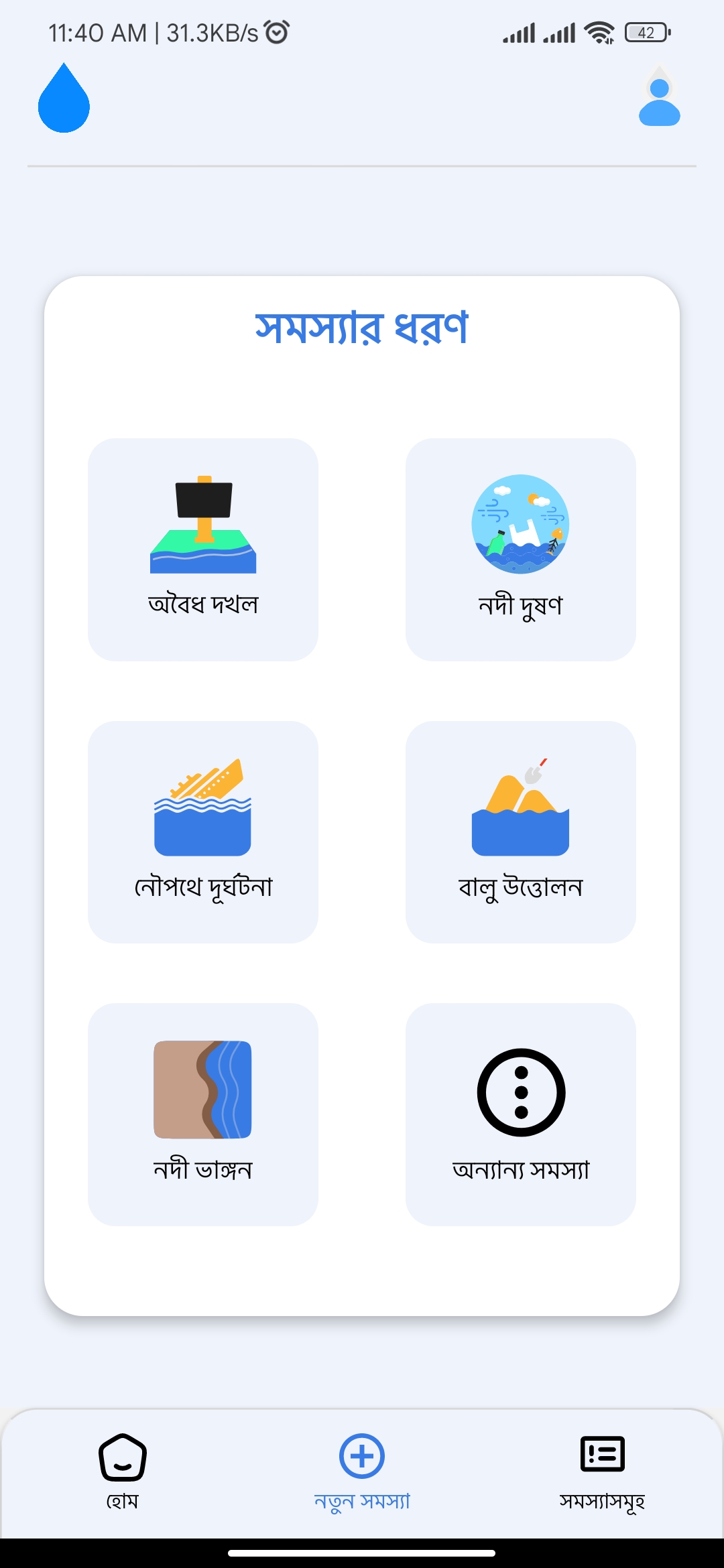
Amar Nodi (My River)

A nationwide dual-mobile app and web administration platform funded by the Bangladesh government for citizens and field investigators to report, verify, and resolve water resource issues.

Role & Contribution:Full-Stack Developer & Team Lead

Led a 5-engineer team to architect the complete 60+ endpoint backend REST service and developed core native mobile modules.

Problem: The national government lacked a centralized, real-time ecosystem for citizens to report water resource violations (pollution, encroachment) and for field officers to track resolutions.

Architecture: Designed a multi-client ecosystem with two React Native apps (Citizen & Investigator) communicating with a Node.js/Express Backend and a MySQL database deployed on AWS EC2.

Technical Decisions: Implemented geospatial queries using Google Maps API for precise incident mapping.

Outcomes: The platform was successfully completed and delivered to the government.

>Technologies Used

React NativeNode.jsExpress.jsMySQLAWS (EC2)Google Maps API
// System Architecture Diagram
                  graph TD
    %% Amar Nodi Architecture
    subgraph Mobile Apps
        Citizen[Citizen App\nReact Native]
        Investigator[Investigator App\nReact Native]
    end

    subgraph AWS Cloud [AWS Cloud Infrastructure]
        Backend[Node.js / Express Backend\nEC2 Instances]
    end

    subgraph Third Party
        Maps[Google Maps API]
    end

    Citizen -- HTTPS --> Backend
    Investigator -- HTTPS --> Backend
    
    Citizen -- Direct Upload --> Backend
    Investigator -- Direct Upload --> Backend
    
    Citizen -.-> Maps
    Investigator -.-> Maps
                
Movie & TV Metadata Aggregation SystemRelease: 2019

ISP_FTP

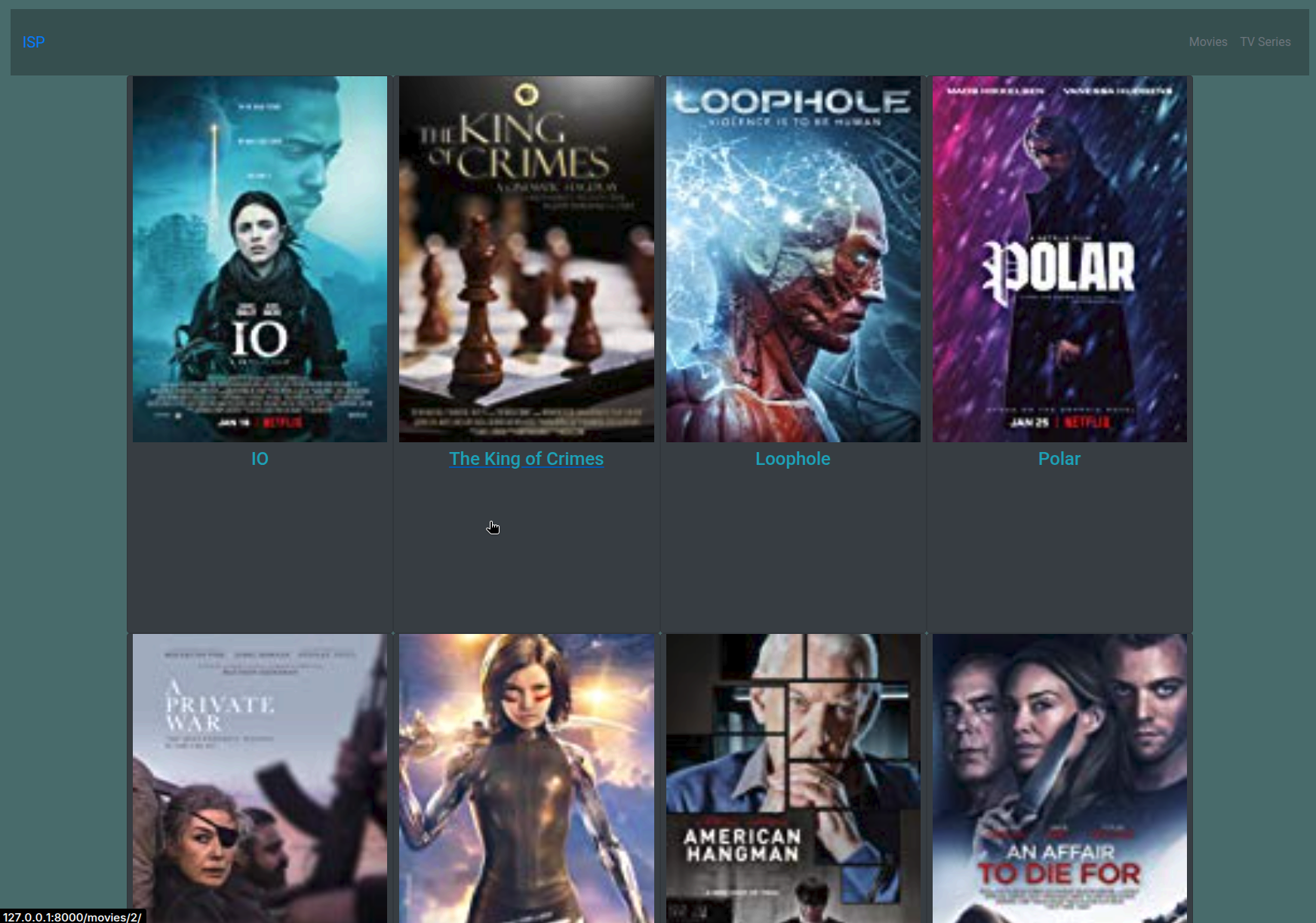
A Python/Django-based media catalog and automation system designed to reduce manual work in building a structured movie and TV-series library by crawling remote media directories, extracting titles, and automatically enriching them with IMDb metadata and artwork.

Role & Contribution:Backend Engineer

Built a Django web application around a reusable media-ingestion backend. Implemented recursive parsing of remote media directories, automated poster retrieval, and IMDb integration.

Problem: Building structured media libraries from raw remote directories is highly manual and time-consuming without automated metadata extraction.

Architecture: Remote media directories are parsed via BeautifulSoup/lxml, titles are extracted, enriched via IMDbPY, downloaded via Pillow, and stored in Django ORM with SQLite.

Technical Decisions: Utilized Django ORM and SQLite for structured persistence, decoupled the automated ingestion endpoint from the presentation layer, and implemented robust fallback handlers for missing artwork.

Outcomes: Delivered a fully functional media catalog system with separate modules for movies and TV shows, enabling single-click ingestion from remote media servers.

>Technologies Used

PythonDjango 2.2Django ORMSQLiteIMDbPYBeautifulSouplxmlPillowBootstrap
// System Architecture Diagram
                  graph TD
    %% ISP_FTP Architecture
    subgraph Ingestion [Ingestion Pipeline]
        Crawl[Remote Media Directories]
        Parse[URL/HTML Parser\nBeautifulSoup / lxml]
        Extract[Filename & Title Extraction]
        IMDb[IMDb Metadata Enrichment\nIMDbPY]
        ImageDL[Image Download\nPillow]
    end

    subgraph Storage [Persistence Layer]
        ORM[Django ORM]
        SQLite[(SQLite Database)]
        Media[(Local Media Storage)]
    end

    subgraph Frontend [Web Interface]
        DjangoViews[Django Views & Templates]
        UI[Movie/TV Web Interface\nBootstrap 4]
    end

    Crawl --> Parse
    Parse --> Extract
    Extract --> IMDb
    IMDb --> ImageDL
    ImageDL --> ORM

    ORM --> SQLite
    ORM --> Media

    SQLite --> DjangoViews
    Media --> DjangoViews
    DjangoViews --> UI
    
    classDef pipeline fill:#1a1a1a,stroke:#deec56,stroke-width:1px,color:#fff;
    classDef db fill:#121212,stroke:#38bdf8,stroke-width:1px,color:#fff;
    
    class Crawl,Parse,Extract,IMDb,ImageDL pipeline;
    class SQLite,Media db;
                
// research and writing02
Paper 01November 2022

A Novel Method for Imbalanced Data Classification based on Label Reassignment

Ahmed Shabab Noor, Afsana Airin, Rezab Ud Dawla, Ahmed Rafi Hasan, Muhib Al Hasan, Akib Zaman, Dewan Md. Farid
TENCON 2022 - 2022 IEEE Region 10 Conference (TENCON)
Hong KongIEEE

Proposes a novel Label Reassignment approach designed to tackle class-imbalance in classification by reassigning majority class instances in overlapping decision boundaries to the minority class. Empirical results demonstrate significant improvements over SMOTE in Recall and F1-Score.

Imbalanced DataLabel ReassignmentMachine LearningDecision BoundariesSMOTEClassification
Paper 02December 2022

Attention-Based Scene Graph Generation: A Review

Afsana Airin, Rezab Ud Dawla, Ahmed Shabab Noor, Muhib Al Hasan, Ahmed Rafi Hasan, Akib Zaman, Dewan Md. Farid
2022 14th International Conference on Software, Knowledge, Information Management and Applications (SKIMA)
Phnom Penh, CambodiaIEEE

A thorough systematic review and comparative analysis of recent attention-based methodologies in Scene Graph Generation (SGG). Evaluates object relation detection, graph neural networks (GNNs), visual relationship predicates, and perceptual scene comprehension with context-aware attention mechanisms.

Scene Graph GenerationAttention MechanismsComputer VisionGraph Neural NetworksVisual Relations
Paper 03September 2022

The Impact of Data Locality on the Performance of Cluster-Based Under-Sampling

Ahmed Shabab Noor, Muhib Al Hasan, Ahmed Rafi Hasan, Rezab Ud Dawla, Afsana Airin, Akib Zaman, Dewan Md. Farid
Machine Intelligence and Emerging Technologies (MIET 2022) / LNICST Vol. 490
Noakhali, BangladeshSpringer Nature

Investigates the role of spatial data locality and density clustering on the stability of under-sampling methods for highly skewed datasets, demonstrating empirical gains in decision boundary preservation and minority class recall using cluster-based under-sampling and ensemble learning.

Data LocalityCluster-Based Under-SamplingClass ImbalanceEnsemble LearningSupervised Learning
// academic background03

Education

01Oct 2025 – Present
BRAC University

Master of Science in Computer Science

Major: Data Science

Advanced research in machine learning architectures, statistical data modeling, and ML pipelines.

02Jan 2019 – Jan 2023
United International University

Bachelor of Science in Computer Science and Engineering

Major: Data Science
Thesis: Improvement of Scene Understanding using Scene Graphs
CGPA3.85 / 4.00

Graduated with high distinction (CGPA 3.85/4.00) with research work focusing on Computer Vision, Scene Graphs, and Imbalanced Data Classification.

Courses
Software EngineeringSoftware ArchitectureArtificial IntelligenceMachine LearningDigital Image ProcessingDatabase Management SystemsBioinformatics
03Aug 2014 – Jul 2018
Feni Computer Institute

Diploma in Engineering

Major: Data Telecommunications & Networking Technology

Comprehensive foundational training in networking protocols, hardware architecture, Linux system administration, and telecommunications.

// work history04

Experience

Feb 2026 – PresentDubai, UAE | RemoteCurrent

Lead Software Engineer · Orexza

Leading backend and platform engineering for a multi-tenant SaaS product. Built an LLM-powered structured data extraction pipeline (LangChain, OpenRouter, Pydantic structured outputs, model fallback, prompt versioning), and designed PostgreSQL schema-isolated multi-tenancy, event-driven analytics, HMAC service auth, and OpenTelemetry observability.

LangChainOpenRouterPydanticFastAPINode.jsPostgreSQLShopify APIRedisOpenTelemetryGrafana AlloyPrometheusLokiTempoDockerGitHub Actions
May 2024 – Jan 2026San Francisco, USA | Remote

Software Engineer II · UJET.CX

Promoted to SE IISev-0 Mitigated

Shipped two production features in a 13+ year-old Rails monolith serving hundreds of thousands of concurrent users with no Sev-1 incidents. Promoted to SE II; led remediation during a Google Code Red incident, helping retain two enterprise customers and protect a multi-million-dollar deal.

Ruby on RailsKubernetes (GKE)Google Cloud (GCP)MySQLRedisSidekiqGitLab FlowGitHub ActionsMicroservices
Apr 2023 – Aug 2023Dhaka, BD | Contractual

Software Engineering Lead · National River Conservation Commission

Led a 5-member team delivering a government platform for citizens to report river issues to authorities. Architected the AWS backend for a public app, an investigator app, and an admin dashboard, and served as primary stakeholder liaison.

Node.jsNext.jsReact NativeMySQLAWS EC2AWS S3REST APIs
// direct reach05

Contact

Open to senior backend, platform, and applied AI engineering opportunities.

Phone
+8801736480320